
Technical Application Knowledge: From practice, for practice
Lighting applications such as backlighting, sidelighting and light ceilings require precise planning to achieve uniform light distribution, high efficiency and reliable performance. Instead of relying on assumptions, a structured design process ensures that every project is based on clear technical parameters and validated calculations.
From project idea to technical solution
The design process begins with defining the application. Whether it is a light ceiling in an office, a backlit sign or a light wall, each application has specific requirements that influence the final lighting result.
To capture these requirements, Inventronics provides dedicated checklists for each application type. These checklists collect all relevant project data, including dimensions, material properties, required brightness and control options. For example, light ceiling projects require additional information such as room dimensions and mounting height to simulate realistic lighting conditions. Providing accurate and complete input is essential, as it directly impacts the quality of the lighting design.
Photometric design and led calculation
Based on the submitted data, a photometric calculation is carried out. This step defines the optimal configuration of LED modules, including their number, spacing and overall system power.
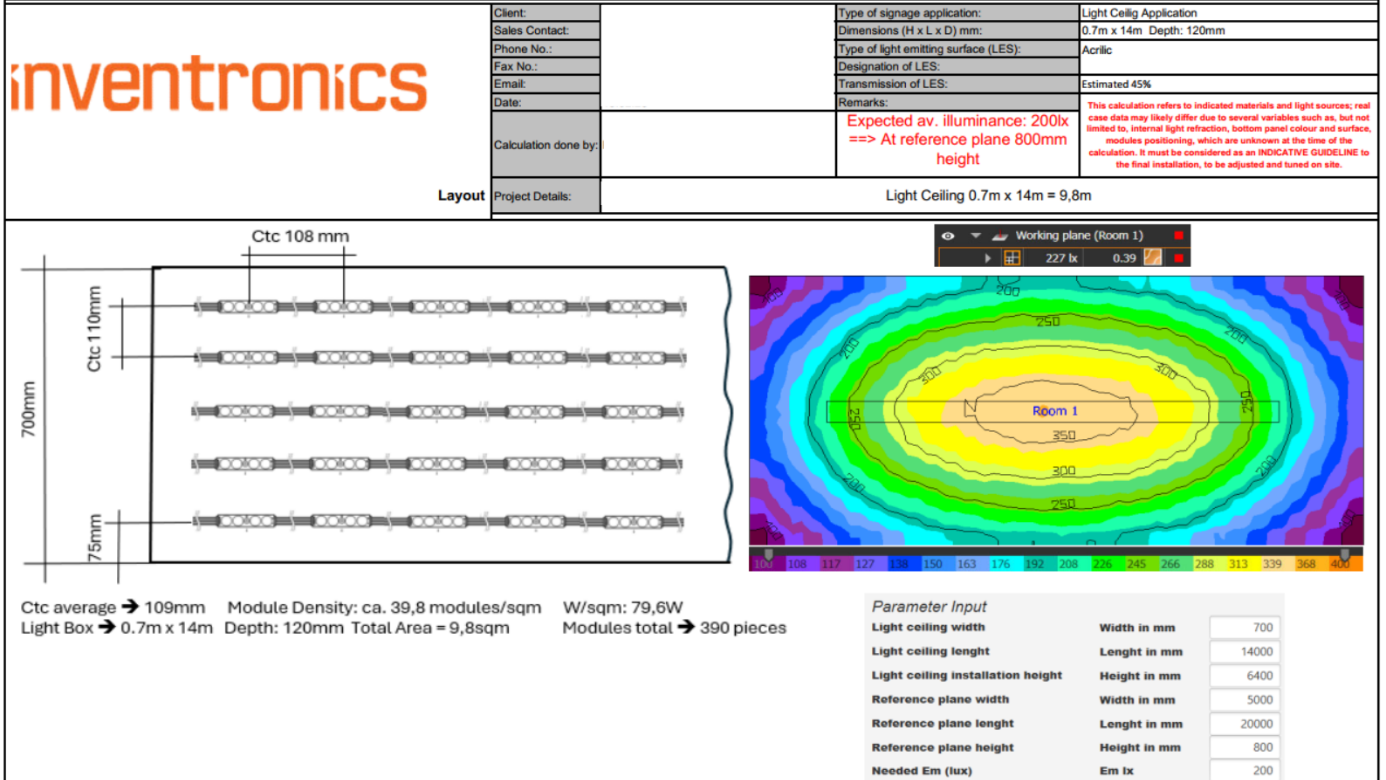
The result is a tailored lighting concept that meets the required illuminance and uniformity. For instance, a typical light ceiling application can be designed to achieve defined lux levels at a specific reference plane using a calculated number of LED modules. These calculations are based on simulation and serve as a reliable guideline for implementation.
From layout to complete system
In addition to the calculation, customers receive a detailed LED layout showing the exact positioning of modules within the application. This ensures consistent light distribution and simplifies installation planning. A complete bill of materials (BOM) is also provided, including LED modules and suitable drivers. This allows customers to directly proceed with procurement and project preparation.

Visualizing light distribution
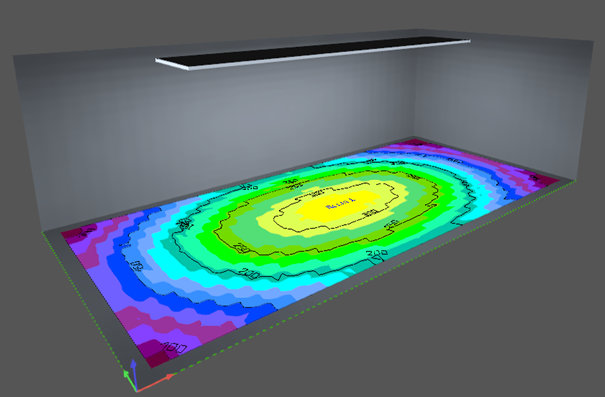
For light ceilings and similar applications, it is possible to generate a false color visualization of the illuminance distribution. This helps to quickly identify brightness levels, evaluate uniformity and optimize the design before installation.
From planning to realization
Once the design is finalized, the process continues with quotation, ordering of components and project execution. The provided documentation supports a smooth transition from planning to installation. It is important to note that the lighting design is based on defined assumptions. Actual results may vary depending on factors such as material properties, reflectivity and installation conditions.
Conclusion
A professional lighting solution is the result of a structured and data-driven process. By combining detailed input, photometric calculation and system-level planning, Inventronics enables efficient and reliable designs for backlighting, sidelighting and light ceiling applications.
Do you have a project where you need to make a lighting calculation for backlighting, sidelighting or light ceiling application? Our lighting experts support you in creating the optimal LED module distribution and bill of material. Simply fill out the appropriate checklist and send it to us.
Link to solution: Sidelighting, Backlighting or Lightceiling Designer – INVENTRONICS GLOBAL (EN)
Calculation with a detailed LED layout showing the exact positioning of modules within the application. A complete bill of materials (BOM) is also provided, including LED modules and suitable drivers. The result is a tailored lighting concept that achieves the required illuminance and uniformity. Using simulation, the optimal number and arrangement of LED modules is defined to meet specified lux levels and provide a reliable basis for implementation.
Visit our designer page to get started.